
Barographs: Measure the weather in style
Barographs: last week's weather at a glance A barometer tells you what the air pressure is doing right now. A barograph records the progression over several days on paper, and that's a fundamental difference: you don't just see that the pressure is dropping, but how fast, for how long, and if it fits a pattern you've seen before.
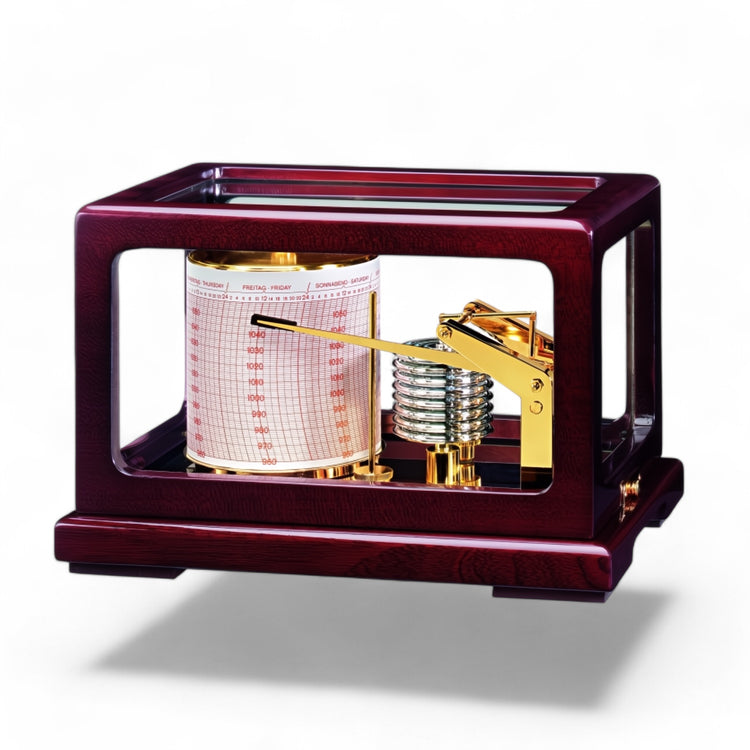
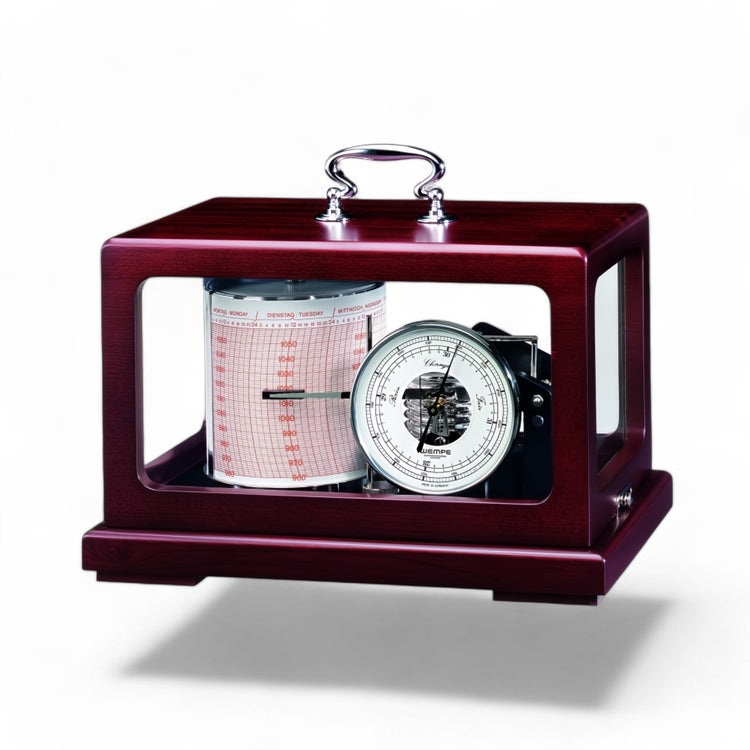
How it works. An aneroid pressure cell expands and contracts with air pressure. This movement is transferred via a lever arm to a pen, which writes on a paper strip around a drum that slowly rotates, usually one revolution per week. The result is a continuous curve in which an approaching depression appears as a clear slope, often long before you notice anything outside.
Who benefits from it. Sailors on multi-day trips who want to build their weather picture. People living on the coast who seriously follow the weather. And enthusiasts who simply enjoy seeing how a system passes over. About operation. A barograph requires something from you: a new strip weekly, occasional ink refills, and adjusting the clock once a year. For most owners, this is not a burden but rather its charm; it's an instrument you interact with, not just a screen showing a number.
Paper and ink in stock. This is why you buy from a specialist. A barograph without refills is an ornamental piece, and the strips are brand and model-specific. We keep paper and ink in stock, even for older instruments. If you don't know what size you need, send a photo of your drum, and we'll figure it out. View parts and service.
The instruments themselves are housed in mahogany or wooden cases with glass windows, classic pieces that immediately draw attention on a chart table or mantelpiece. Looking for something simpler? Check out barometers or weather stations.
8 products
Sort by:
8 products

At sea, air pressure is your earliest warning system. A falling line on the barograph tells you hours in advance what the horizon still hides. The Wempe Drum Barograph has proven its worth on board countless ships – not as a gadget, but as a silent companion that never sleeps. Every week a new sheet of paper, every line a story of wind, water, and changing weather. This is the instrument that experienced sailors trust when the sky starts to lie. The WEMPE drum barograph (265 x 170 x 175 mm) weighs 3100 grams and comes with a writing pen and 52 diagram papers (hPa or inches), one for each week of the year.


This Fischer barograph continuously records air pressure and is intended for situations where weather developments are not only read, but also monitored. The instrument is suitable on board, in a wheelhouse, weather room, office or maritime space where measurement reliability and readability are paramount.
The measurement system uses a 7-fold aneroid diaphragm box made of copper-beryllium alloy. Thanks to temperature compensation with bimetal and a precision mechanical movement with stone-mounted axes, the recording remains stable and accurate, with minimal static friction. The versions are available with mechanical or quartz movement; the ship's barographs are also equipped with a vibration-dampened measuring mechanism for use at sea.
The series consists of four models: standard barograph or marine barograph, each with mechanical or quartz movement. This makes it an instrument line for both fixed installation ashore and nautical deployment with silent precision.


The Plastimo barograph does what no barometer can: it remembers. With an accurate aneroid mechanism, a stylus continuously records the atmospheric pressure on a rotating paper drum. This allows you to see not only the current atmospheric pressure, but also how the weather has developed over the past few days. A classic maritime instrument that has been used for generations on board, at home and in weather stations.


Wempe Barograph Chart Paper: For 52 Weeks of Accurate Recording. Keep your Wempe drum barograph always operational with this set of 52 chart sheets, available in hPa or inches. Specially designed for models CW810002, CW810003, and CW810004, this paper provides a flawless record of atmospheric changes, week after week. This paper roll will keep your barograph running smoothly for a year and ready to capture every moment of weather. An essential addition for any barograph enthusiast who doesn't want to miss a pattern or trend. Always have a set on hand to capture the fascinating movements of the atmosphere.

Wempe Replacement Faser Scribe: For unparalleled precision from your Wempe drum barograph. Refine the performance of your Wempe drum barograph with this advanced replacement pen, also known as a Faser Scribe. Designed for the CW810002 model, this pen increases the accuracy of your atmospheric measurements and takes your weather recording to a higher level. An indispensable addition for the demanding user who wants to capture every detail of air pressure changes. Order today and experience the difference in precision this pen offers.

Enhance the performance of your Wempe Marine barograph with this advanced replacement pen, also known as a phaser scriber. Specially designed for model CW810002, this pen ensures maximum accuracy in your atmospheric measurements and brings your weather recording back to the desired level. An indispensable accessory for the precision and detail enthusiast who doesn't want to miss a single air pressure change. Although the Wempe Marine barograph itself is no longer available, we offer this nostalgic addition for those who want to keep maritime heritage alive. Order today and experience the difference this pen makes.


Wempe Marine Barograph Chart Paper – For Accurate Year-Round Recording Optimize the use of your Wempe Marine barograph with this chart paper roll, designed for accurate weather recording for a year. Ideal for tracking weather patterns, it's essential for both professional sailors and dedicated maritime enthusiasts. While the Wempe Marine barograph itself is no longer available, this chart paper remains the perfect complement for recording atmospheric changes. This chart roll is compatible with the Wempe Marine barograph – keeping your instrument operational and your data complete, all year round.


A year's worth of weather insights. Specially developed for the Wempe/Räber Meteograph, each roll provides 365 days of continuous monitoring – ideal for meteorological analysis and reliable climate insights. Each roll provides a year of reliable weather data recording. This chart roll guarantees durability and accurate weather pattern recording for meteorological, marine, and research purposes. Easy to install for continuous monitoring and analysis. With this Meteograph blue wax chart paper, you are once again assured of accurate weather data. Easy to install and perfect for the amateur weather enthusiast as well as for professional use in meteorology, marine, and research. Although the Wempe Marine Barograph itself is no longer available, this chart paper remains the perfect addition for recording weather changes. Choose from a single roll or a set of five, available with hPa or inch scales.
Popular collections for sea and outdoor enthusiasts


Choose your color


Frequently asked questions
A barograph is a barometer with a writing arm that accurately records changes in air pressure, as it rises and falls, on a rotating paper roll. This instrument is indispensable for weather forecasting enthusiasts, as well as professionals who want to monitor pressure changes in real time.
View the current air pressure and compare it with previous measurements. Rapid changes indicate short-term weather changes, while slow changes point to long-term changes in the weather. Because the barograph 'sketches' it on paper, you can review the paper roll or sheet (depending on the type of barograph) and assess the graph.
A barograph measures air pressure. It is a marine instrument that records changes in atmospheric pressure over a certain period on a paper roll. This allows you to easily monitor and analyze changes in air pressure, which is useful for weather forecasting and navigation at sea, but certainly also interesting for home use. Or as a corporate gift.
A barograph measures and records air pressure; a barometer measures air pressure. Unlike a barometer which shows the current air pressure, a barograph records weather changes on paper, allowing you to always see and follow patterns.
Most barographs come with a year's supply of paper. Some models use a 365-day roll, which you only replace once a year. Other models use individual weekly sheets, which you replace every week. Check your model to see what type of paper it uses and how often you need to replace it.
A barograph records atmospheric pressure. A meteograph is a versatile instrument that measures and records multiple weather conditions, such as temperature, humidity, and atmospheric pressure. Unlike the barograph, which only records the atmospheric pressure line, the meteograph records various weather aspects simultaneously on a single timeline. Meteographs are often used for detailed climate analyses and meteorological studies, where multiple data points are needed simultaneously.
Follow us on Instagram
@studio_maritime


